Pymble Institute Newsletter – Issue 16 -
Editorial

Editorial

We have had great pleasure this year in the Pymble Institute connecting with four dynamic people who exude passion for their work in research and academia. As 2025 comes to a close, I’d like to reflect on how important universities are for schools and share my observations on why school communities benefit richly from partnerships, of different kinds, with academics.

This editorial also serves as a public thank you and vocal shout out to our colleagues in tertiary education who are genuinely interested in and caring about Kindergarten to Year 12 education. We appreciate your support for current teachers, the next generation of teachers, children and young people in our schools, and the wider public domain where knowledge, in all its forms, is expressed and debated.

The Pymble Institute’s 2025 Research Fellow was Dr Bosco Rowland, a registered psychologist and Senior Research Fellow with Monash University in Melbourne. Bosco’s face to face visits and workshops with students, staff and parents have helped shape the philosophy behind the College’s new Service Framework. By understanding the research about what makes a difference to the mental health of children and young people, and locating acts of helping and serving as a key dimension, we have developed an approach based in current Australian and international best practice. Thank you Bosco for playing a pivotal role in helping us develop the Social Intelligence Strategic Pillar through your care, support and inspiration.

The 2026 Pymble Institute Research Fellow is Associate Professor Sophie Gee. Sophie is an academic in the English Department at Princeton University in the United States and the inaugural Vice-Chancellor Fellow at the University of Sydney. In this latter role, Sophie focuses on public intellectual discourse and collaboration which is ideal for schools. We loved Sophie’s special lecture for the Pymble Institute earlier this year on what happens when we read and why studies in the humanities can enrich the lifeworlds of all. Sophie has kindly accepted our invitation to further share her wisdom with Pymble Ladies’ College in 2026 as our third Research Fellow. We are excited about the projects she will support us for our Academic Intelligence Strategic Pillar, namely the Teaching and Learning Framework, the Conde Library, our English Department’s leadership of the College’s reading culture, and working with the History, Society and Ethics Department.

We welcomed Professor Simon Buckingham Shum from the University of Technology Sydney to lead one of the first, all-staff professional learning events of 2025 with a focus on our strategy in Digital Intelligence. Thank you, Simon, for bringing your scholarly mind and deep care to the topic of AI in education. Simon’s words and concepts are still resonating as they provoked a much better understanding of how our work at Pymble fits into the tertiary landscape into which our students are heading. Speaking to an audience of over 300 staff from Kindergarten to Year 12 teachers, as well as  our professional services, coaching, boarding and health care staff is a significant opportunity, and Simon’s keynote presentation and follow up workshops exemplified both cutting-edge innovation and care and respect for everyone lucky enough to attend. We’re sure to work with Simon again soon as AI moves more and more into our lives.

To conclude the year, in Term 4, a special keynote to support the Teaching and Learning Framework was delivered by Penny van Bergen, Associate Professor in Educational Psychology in the School of Education at Macquarie University. As a taster for further work with Pymble teachers in 2026, Penny lead us through key research principles in the areas of memory, cognition, learning and knowledge and linked these to both the Academic Intelligence and Emotional Intelligence Strategic Pillars. Penny’s enormous warmth and energy, and rigorous interrogation of the field of learning sciences, was sincerely appreciated by all – especially the respect Penny gave teachers in terms of their professional expertise and knowledge of their students.

This is quite a list! 2025 has been a year of much learning; enriched immeasurably by the research and scholarship of Bosco, Sophie, Simon and Penny. We appreciate and acknowledge each of these education experts and thank them for being part of our collective commitment to our profession, and the children and young people we serve.

Thank you all for your support of our work at the Pymble Institute. We wish you all a happy and restful holiday time and a great start to 2026.
Pymble Wise Phone Initiative – Phase 2 Research Report

Pymble Wise Phone Initiative – Phase 2 Research Report

The Pymble Institute is pleased to complete the second research report into the Pymble Wise Phone Initiative. A key finding is that the school-managed, reduced-internet access phone is helping students to achieve better focus and attention in class, as well as better sleep and time for hobbies and recreation. The second report uses data from students, parents and staff that were collected midway through the pilot year in June 2025.

The first report in the series can be read here.


The second report can be read here.

The Wise Phone initiative was launched in November 2024 and is now coming to the end of its first year. Through this work, the College aims to interrupt negative cycles of unregulated mobile phone and internet browser use by offering parents a school-managed, restricted-function mobile phone option. The research in the second report was designed to investigate how phone usage has changed since the first survey and whether student behaviours (including sleep, physical exercise, friendships and focus on schoolwork) have changed. We also compared the internet usage and online risks taken by our Year 4 to 8 students with national statistics using the Australian eSafety Commissioner’s 2022 report on the digital lives of Australian children. This excellent report, Mind the Gap, is recommended reading. 

Pymble’s second phase of research employed a mixed-methods approach with:
  1. An online survey administered to students and parents across Years 4 to 8. Quantitative analysis was conducted using statistical tests, including Chi-square and Kruskal-Wallis H tests, to explore the relationship between phone type and key student outcomes.
  2. Qualitative insights gathered through focus group and individual interviews with College staff members to understand how the phone initiative was impacting student wellbeing and staff workload.
  3. A social lab research approach was piloted with a Year 5 Mathematics class. In this participatory research approach, students generated research questions of interest to them and conducted data collection and analysis amongst their class and year group with teacher and researcher support.
What did we learn?

The Pymble Wise Phone remains the dominant device for students across Years 4 to 7, either exclusively or combined with a smartphone. We found continued positive impacts for students using the College-managed devices, particularly in sleep, but also in their academic focus and ability to manage schoolwork.

A key finding is that Pymble Wise Phone users and students with no phone reported significantly greater focus and attention on their school work compared to those using a smartphone.

Pymble Wise Phone-only users are more likely to achieve the recommended nine or more hours of sleep (43.3%) compared to smartphone-only users (26.2%). We were also interested to learn that Pymble students reported a lower incidence of risky online behaviour, such as sending personal information or photos to strangers (2%) compared to the national figure (11%). However, the report highlights that our students are less likely to tell their teachers about a negative online experience, with older students more likely to ignore the problem or block the perpetrator. This indicates a valuable direction for continued cyber-education.

The data collection for the third phase of the research project is currently underway and will continue to support the College’s implementation, improvement and understanding of mobile phone and internet usage amongst our students.

Anti-racism education research with Professor Fiona White

Anti-racism education research with Professor Fiona White

Social Intelligence is one of the College’s strategic pillars and a recent opportunity to work again with Professor Fiona White, Professor of Social Psychology, from the School of Psychology at the University of Sydney, was welcomely received by Pymble Ladies’ College.

In her latest research project: “RESPECT Against Racism: Advancing new anti-racist educational e-modules”, Professor White and Dr Alexandra Wong will develop and evaluate a set of online modules, co-created with cool.org and underpinned by leading anti-racism approaches. The modules use resources which will support Year 5 and 6 teachers’ delivery of an engaging and educational anti-racism curriculum and support schools to guide young people in the creation of culturally inclusive communities.

The project is especially timely as Australian society is faced with issues of stereotyping and prejudice. The College agrees with the research team that primary school teachers have a significant role to play in supporting the next generation in their development of kind, pro-social and inclusive beliefs. Professor White’s ABC documentary (The School That Tried to End Racism), and her 30 years of research in this area, shows that young children are very aware of racism and have the skills to discuss it.

The Pymble Institute took the research proposal to the College Ethics Committee, which approved it. The Committee is made up of students and teachers, and the group gave valuable feedback to the academics including clarifying the composition and methodology of the focus groups, and ideas for expanding the project to students and parents, if future funding made this possible. We are now helping to recruit interested Junior School teachers.

This will be our second research collaboration with Professor White. Our prior collaboration in 2022 and 2023 resulted in a student-developed, anti-racism and prejudice reduction curriculum. That project was initiated by a group of Senior School students intent on making sure racism experienced by some communities during the COVID-19 outbreak did not take root in their own school or local communities.

Professor White would love to hear from other schools interested in participating in her research. We are excited to see what results from this new research initiative.


Calling Pymble Alumni! We’d love to connect

Calling Pymble Alumni! We’d love to connect

Are you a graduate of Pymble Ladies’ College and now studying and/or working in your area of speciality with research as part of your world? The Pymble Institute and Director Sarah Loch would love to connect, or reconnect, with you through the new Pymble Connections portal, which is now open for all College Alumni.

Pymble Connections is the College’s brand new alumni portal, which allows graduates to stay in touch, build networks, post updates on their work and search for opportunities. One of the goals of the Pymble Institute is to create networks among women in academia and research and to help women succeed in areas of under-representation – which unfortunately includes many research and scholarly fields.

To help change this situation and to inspire current students, we’d love to connect with a wide range of Pymble women working in many fields, undertaking formal study, working in universities, and leading and participating in research programs. We’d love to invite you back to the College to share your stories, assist with guest speaker and judging roles, speak with interested staff and students, mentor students in Sokratis and other programs, and provide advice to future researchers.

Connect to Pymble Connections via this link.

The art of research posters

The art of research posters

An interesting change happened this term and it’s one worth sharing. After three years of running the student research program, Sokratis, which is open to all students from Year 7 to 11 and is based on topics of students’ own interest, we had a breakthrough.

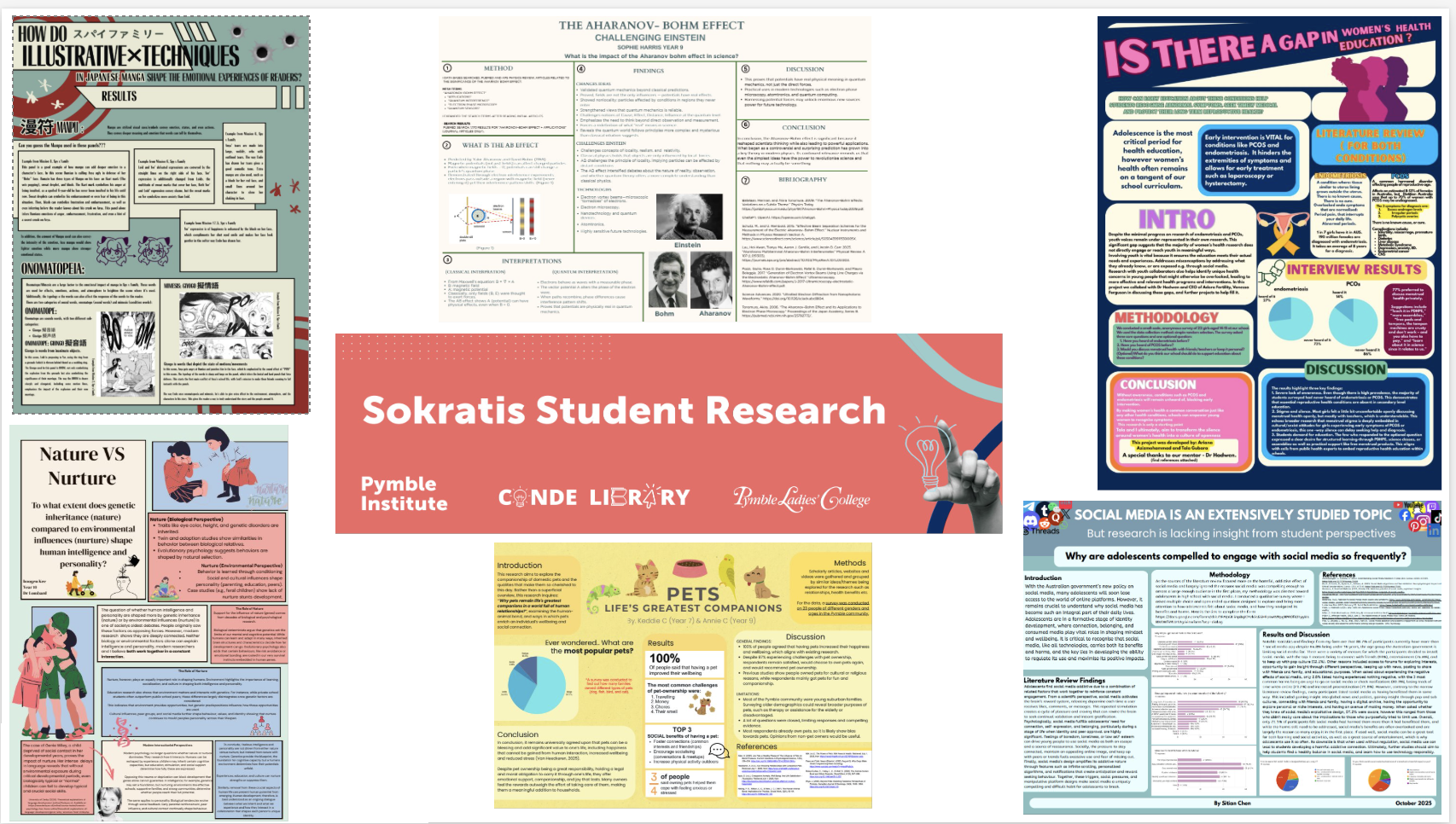
The quality of the research posters the students produced was so much better!

After identifying their topic, connecting with a mentor (a member of staff or a Year 12 student), writing a research question and locating reliable information, students spend the bulk of the year working through their research. I have worked with my brilliant colleagues from the Conde Library Team, Spencer Toohey and Tessa Zwar, and Victoria Adamovich, the Pymble Institute Research Associate, to populate an online learning module with a range of resources – including support for different ways to create research posters. The various modules move students through all stages of the research process to arrive at a concluding point in October when posters are due and the Showcase is created in Conde Library.

We’ve been talking about what happened to lift the standard of posters. Posters in the 2025 Showcase are reflecting more conventional features, such as boxes of information and eye-catching tables and graphs, but also audience-engagement tools such as rhetorical questions and voting opportunities. We placed a paper pocket next to each poster along with blank feedback cards and invited the visiting staff, students and parents to share their thoughts with the student researcher. Ultimately, we put the improvement down to persistence and consistency as we have not done anything very differently, but the parts of the research journey are starting to click together. We would like to note that, like good research, good research learning takes time, patience, good examples and effort. We’re excited to see what 2026 brings!

Who won? The Best Poster Design was won by a Year 8 student with her topic, How do illustrative techniques in Japanese manga shape the emotional experiences of readers? Congratulations to the student and mentor team behind this research project and to all those who participated.


Researcher Spotlight

Researcher Spotlight

In this interview with Lucy Eaton, we ask her some questions about her passion for research in the area of dance education. Lucy’s article Dialects of Contemporary Dance in Sydney, Australia: Identification and Response will be published in the next edition of Illuminate. 

  1. What is your role in the College?

I am the Secondary Dance Co-ordinator here at Pymble.

  1. What course have you been studying?

I have recently completed the Master of Arts in Education (Dance Teaching), a 3-year (part-time) course offered through the Royal Academy of Dance (RAD) and ratified by the University of Bath.

  1. What was the topic of your thesis? Can you describe it in about 100 words?

I could barely describe it in 15,000 words! The research was a short-practice led examination of disparities in contemporary dance education in Sydney’s private sector, looking at challenges resulting from a lack of regulation and standardisation in pre-professional training using a cast of ten female contemporary dancers as the sample group.

The study investigated the impact of geographic location on teaching and learning across four Sydney Local Government Areas, exploring how regional dialects, symbols, and language can affect movement. The idea was that each dancers’ body carries these imprints of experiences, recreating affectations or flourishes and reinventing movement vocabulary with each performance. It also examined the use of codified modern dance techniques in addressing movement affectations.

In the end, findings suggested that tailoring modern dance techniques to address regional dialects can improve pre-professional dance training outcomes, with teacher awareness of student context enhancing technique and performance and bridging the gap between education and industry standards in contemporary dance training. It sort of affirmed the Ouroboros-style in which contemporary dance evolves.

  1. What led you to study with an overseas university?

There are limited tertiary pathways in Australia for dance-specific post-graduate study. There are even (comparably) limited undergraduate opportunities in dance. The RAD is a global institution which so many dancers engage with from the beginning of their training. I think that the course being offered anywhere is great, but to be mentored by staff at the RAD at this level is really significant. I liked working alongside dance teachers from across the world; it was interesting how unified we felt.

  1. People don’t always think of dancers as having an academic pathway. What has drawn you in this direction?

In part, the very fact that dance isn’t considered to be a legitimate academic pursuit is what drove me to study it at this level. The dance industry is not a perfect meritocracy – I feel a deep need to defend the art form that I love so much as being a valid career path, and academia is one way to show that credibility. I have a bit of a supply-demand view of the paths currently available to us. It’s important that dancers and dance teachers actively take up space in academic institutions and engage with opportunities when and where they arise.

While dance is undeniably an art, the body is the toolkit. I think understanding the anatomy, physiology and biomechanics of the movement is imperative to creating great art. I have such respect for what my students do in class (meeting the physical, psychological, emotional and creative demands) and I’d like to reflect their value of dance education in my own practice. I strongly believe that nothing is more worthy of thought, reflection and future-focused research than the physical and emotional experiences of the students in my care.

I think that the dance studio is an underrated workspace in terms of how delicate it can be; it’s no small task to push young people to their physical and cognitive limits in a room full of (sometimes) competitive peers. It’s commonplace to expect teachers to maintain currency, engage in professional development and improve themselves and that should be the expectation for dance teachers, as well. In dance, where there is no textbook and the teacher’s knowledge and/ or experience directly correlates to the safety of a student, the quality of their experience in the studio and the content a cohort learns, holding ourselves to a high educational standard is absolutely necessary.

  1. How has the process of conducting your research and reflecting on the findings influenced your teaching and practice?

Developing postgraduate research through interrogation of my own practice was equally challenging and rewarding. I think I am considering the teaching and learning process to be more reciprocal than instructional. I know that this give-and-take pedagogical style has been at the forefront of program design in a classroom setting for some time, but skill acquisition in the studio context is not usually framed this way. As a result, my passion for the artistry and athleticism in dance education has been refocused.

  1. Have you had a chance to share your research with colleagues or students?

I have just shared an excerpt of my research within an issue of the Pymble Institute’s Illuminate. It’s both exciting and daunting to have my work read by a broader audience.

  1. What do you see as your next steps?

I would love to undertake a PhD next. I have owned a dance company since 2013 called Dance Dr., where a huge amount of my professional work took place, and I’d love to eventually be able to say I am a dance doctor!

The findings of my research have breathed new life into the way I design movement and I look forward to creating choreography with more nuanced consideration of the dancers and their histories in the process.